


You might think you found the perfect tile for your space, but is your space right for that tile?? Before you click that buy now button, there are a few things you need to know to help you decide whether small format or large format tile is the better fit for your project.
What kind of aesthetic do you want?

Big tiles can create a modern, sleek, and open look, with fewer grout lines, making spaces appear larger. Small tiles, on the other hand, offer a more intricate, detailed appearance due to the higher number of tiles and grout lines.
How level are your walls/floors?
For all you new home builds, this probably doesn’t apply. But if you have an older house like me, you may notice the walls and floors aren’t as level/even as they should be. While you want the subfloor or wall to be extremely flat and even regardless of tile choice, you may encounter bigger problems with larger format tile on an uneven surface. Not only could the size exacerbate the unevenness, but uneven surfaces can also cause stress points on the tiles, potentially leading to cracking during or after installation. You may find it easier to conceal imperfect surfaces when using smaller tiles.
Are you DIYing or hiring it out?
Let’s talk level of difficulty. Installing big tiles is typically quicker and requires fewer individual tiles, but precision is crucial due to the larger size. They are also much heavier, it can be more difficult to make precise cuts, and they are more susceptible to breaking or cracking. Installing small tiles is more labor-intensive and time-consuming due to the higher number of tiles to set and grout, but more forgiving for imperfections and mistakes. And if you break one? No biggie. But breaking a big tile can be a $50 mistake.
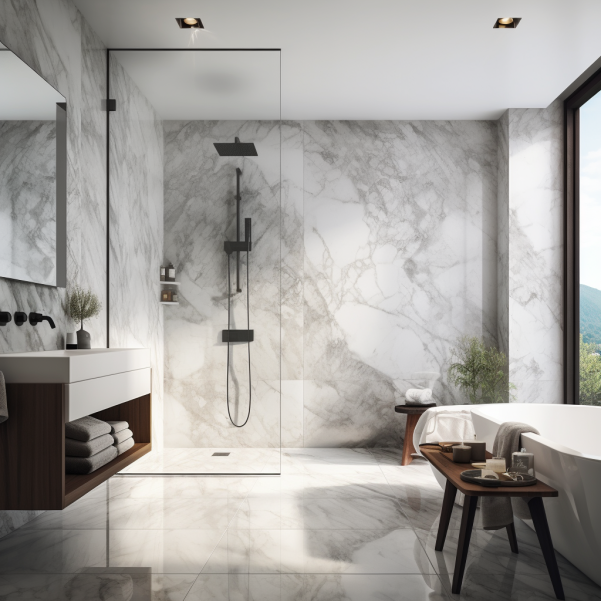
How do you want the room to feel?

Big tiles can make a space feel more open and less cluttered, especially in smaller rooms, as the large format can create a sense of continuity. Small tiles can add texture and detail to a space, making it feel cozier or more intimate.
Think about cleaning.
Big tiles have fewer grout lines, resulting in easier cleaning and a more streamlined look. Small tiles have more grout lines, which can be harder to clean and may require more maintenance. (Particularly if you go for a lighter color grout! )
What is the takeaway?
Larger format tiles offer a modern aesthetic, streamlined appearance, and easier maintenance. However, they may pose challenges during installation and may not be suitable for all spaces, particularly those that may not be perfectly even or level.
Small format tiles offer versatility in design, intricate patterns, and are ideal for creating detailed and visually appealing surfaces. They can be more forgiving on uneven surfaces, can easily fit in tight irregular spaces, and if you break one it doesn’t set you back. However, they come with more grout lines and can be more challenging to align during installation.
Ultimately, the choice between big and small tiles depends on the desired aesthetic, the space you’re working with, your budget, and your preferences regarding maintenance and installation. And friends, that’s all I got for you! As always, if you have specific questions, consult with a professional to help you make an informed choice based on your specific project. If you found this helpful, I’d love to hear below!

Leave a Reply